
Nikro Air Duct Cleaning in Aliso Viejo: A Homeowner’s Guide
Most duct cleaning trucks look identical from the driveway. You see a van, some hoses, maybe a spinning brush. The difference between a Nikro negative-air machine and a residential shop-vac retrofit is not visible until you check the CFM rating and realize one cannot maintain negative pressure across a 2,500 sq ft duct system. That is the thing we want to explain here, because once you understand what the machine actually does, you can hold any contractor to a higher standard. If you would rather skip the technical deep-dive and just get a straight answer about your Aliso Viejo home, call (833) 693-2761.
What Is Nikro Equipment and Why Does It Matter?
Nikro is a manufacturer of professional air duct cleaning systems built specifically for indoor air quality work. These are not modified shop vacs. A Nikro unit is a truck-mounted or portable negative-air machine designed to pull the entire duct system under vacuum while cleaning tools work inside the ductwork. In Aliso Viejo, where many homes are two-story with ducts running through attics and between floors, that negative pressure is the difference between removing contaminants and simply relocating them into the living space.
The core engineering principle is simple. When a Nikro machine runs, it creates continuous suction at the air handler and at each register. The air pressure inside the ducts drops below the air pressure in the rooms around them. That means any dust, debris, or particulate knocked loose during cleaning gets pulled toward the vacuum rather than drifting out through a vent and settling on your couch. It is containment by physics, not by hope.
Cheaper equipment often lacks the CFM rating to hold that pressure on a full-size home system. The machine runs, the brush spins, but air leaks around the connections and debris escapes. A machine that cannot maintain negative pressure across the duct volume is not cleaning. It is redistributing.
The Hardware Behind the Claim: What to Ask Any Contractor
If a company tells you they use professional-grade equipment, ask them to prove it. Not with a brochure. With specifics. These are the questions we would recommend any homeowner in air duct cleaning ask before scheduling work:
- What machine model do you run? A real answer is a make and model. Nikro, Rotobrush, and similar commercial units have names and specs. “A big truck vacuum” is not an answer.
- What is the CFM rating at the machine? For a typical Aliso Viejo single-family home with 15 to 25 runs, you want a unit that moves at least 2,000 to 3,000 CFM before any hose losses. Anything in the low hundreds is a shop-vac with marketing.
- Is the exhaust HEPA-filtered? The vacuum pulls air out of your ducts. Where does that air go? If the exhaust is unfiltered, fine particulates blow right back into the room or out the truck door into your garage. A HEPA-rated exhaust means what comes out is cleaner than what went in.
- Do you verify negative pressure after setup? A competent crew checks pressure at the farthest register before cleaning begins. If they cannot answer that question, they are not running a containment-based process.
These aren’t trick questions. Any company doing this work correctly in Aliso Viejo can answer all four in under a minute.
Why the Rotary Brush Combination Beats Air-Whipping Alone
Some duct cleaners rely on compressed air to blow debris loose. That can work on light dust, but it struggles with what we commonly find in Southern California homes: compacted dust, pet hair woven into flex duct, and construction debris left from original builds or remodels. Aliso Viejo’s housing stock includes a lot of homes built in the 1990s and early 2000s, and plenty of those ducts have never been opened since the drywall went up.
A rotary brush system mechanically agitates the duct walls. Rotobrush equipment, for example, uses a spinning brush head attached to a flexible shaft that runs through the duct while the vacuum pulls. The brush scrubs, the vacuum extracts. That combination matters because it breaks the adhesion between debris and duct surface. Air alone often cannot.
When you pair a Nikro negative-air platform with a rotary brush like a Rotobrush, you get mechanical agitation plus continuous containment. The brush loosens, the vacuum captures. This is the professional standard for a reason. It is also why the equipment choice is not cosmetic. A compressor and a hose can make noise and look busy while leaving half the debris in place. Tools either create enough turbulence to dislodge particulate and enough airflow to move it, or they do not.
Cross-Contamination Between Supply and Return Sides
Your duct system has two sides. The return side pulls air from the home back to the air handler. The supply side pushes conditioned air out to the rooms. During cleaning, both sides need attention, but the sequence matters. If you clean the return side without proper containment, dislodged debris can get pulled into the supply plenum and blown throughout the house. That is the exact opposite of what you paid for.
A negative-air machine like a Nikro unit prevents this by maintaining the pressure differential throughout the process. When set up correctly, the machine creates a continuous draw on the entire system while technicians clean section by section. The return side is cleaned and sealed off. The supply side is cleaned and extracted. Nothing crosses over because air only moves in one direction: toward the vacuum.
This is one of those details that separates a process-driven company from one that is just running hoses. We cannot speak for every operator in Aliso Viejo, but we can tell you that our approach treats the duct system as a single enclosed loop that must stay under control from the first register to the last. Clean ducts are only half the job. Intact ducts are the other half.
HEPA Filtration at the Exhaust Stage: A Failure Point on Cheaper Equipment
Here is a detail most homeowners never think about. Your ducts contain dust, pollen, pet dander, maybe some insect matter, and whatever else has accumulated over the years. During cleaning, that material gets pulled into the vacuum system. It has to go somewhere. On professional equipment, it goes through a filtration bank that includes a HEPA-rated final filter before the air is exhausted. That means the air leaving the machine carries noticeably less particulate than the air that entered it.
On lower-grade equipment, the exhaust is often unfiltered or passes through a coarse filter only. Fine particles, the ones most likely to trigger allergies or asthma, pass right through and re-enter the home through the exhaust stream. You can literally watch this happen on a sunny day: the vacuum runs, and a haze of fine dust wafts out the garage door.
Nikro systems include HEPA filtration at the exhaust stage as part of their design. So does the Abatement Technologies containment equipment we run alongside it. The combination means contaminants captured from your ducts stay captured. They get filtered, bagged, and removed. They do not get blown back into the air you breathe in your Aliso Viejo living room. That is the containment-first standard, and it is the only one we would accept in a home we were working on.
What a Proper Nikro Cleaning Actually Looks Like in an Aliso Viejo Home
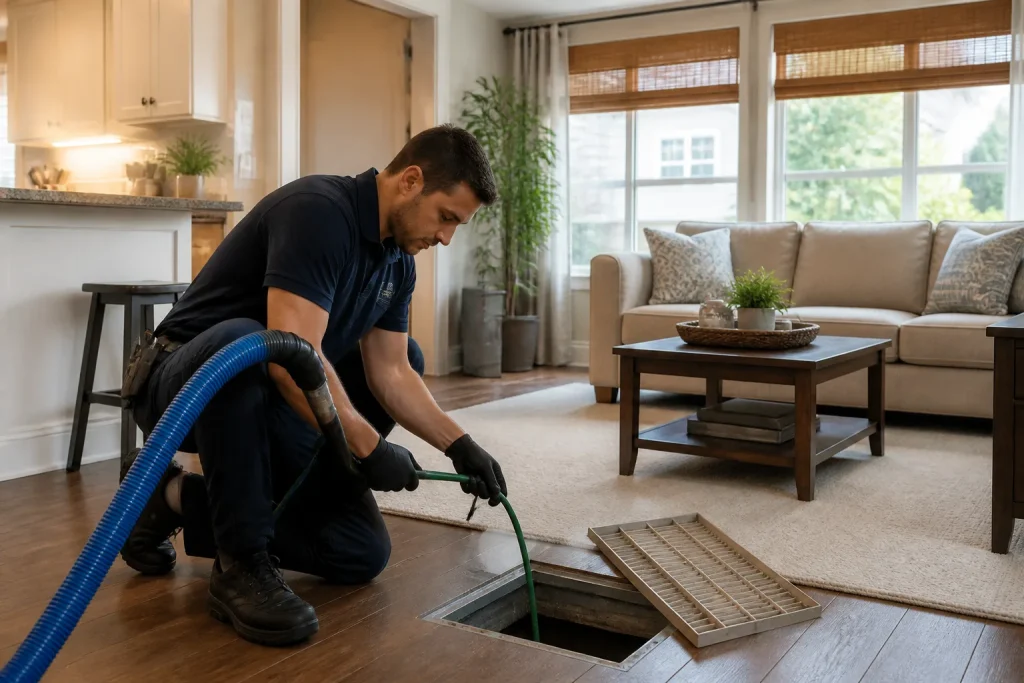
You can expect a few hours of work, not twenty minutes. A typical single-family home in Aliso Viejo takes roughly two to five hours depending on the number of runs, the system layout, and how much debris has accumulated. The process goes something like this:
- Setup and pressure test. The Nikro unit connects to the air handler or main trunk. Technicians seal off registers and confirm negative pressure holds across the system.
- Mechanical agitation. A rotary brush runs through each supply and return run, scrubbing the duct walls and loosening compacted debris.
- Continuous extraction. The negative-air machine pulls loosened debris out of the ducts and through the filtration bank in real time.
- Exhaust verification. The HEPA-filtered exhaust is checked to confirm the unit is operating within spec during cleaning.
- Post-cleaning inspection. Technicians inspect accessible sections with a camera to verify the duct walls are clean and debris has been removed.
After the cleaning, you may want to consider dryer vent cleaning as part of the same visit, especially if your laundry room is on an interior wall or the vent run is long. It is a separate system with its own risks, but the same containment principles apply. From cleaning to repair in one call means if the camera inspection turns up a separated joint, a crushed flex run, or a disconnected boot, we can address it rather than telling you to call someone else.
When to Call a Pro
We are going to be straightforward here. Duct cleaning is not a DIY project. The equipment required to do it properly costs tens of thousands of dollars and requires training to operate safely. A shop-vac and a dryer-vent brush from the hardware store cannot reach more than a few feet into a duct run, cannot maintain negative pressure, and cannot filter the exhaust. You will spend a weekend crawling around your attic and end up with dust on every surface of your home.
If you have never had your ducts cleaned, or you cannot remember the last time, a professional assessment is a reasonable first step. If someone in your home deals with allergy or asthma triggers, or if you have pets that shed, the case is stronger. And if your home has had any recent work done, drywall dust and debris in the ducts is almost guaranteed.
Related services in Aliso Viejo: Duct Cleaning Aliso Viejo covers cleaning, dryer vents, and duct repair.
The Bottom Line
Nikro equipment is not a marketing badge. It is a specific engineering choice that determines whether your duct cleaning actually removes contaminants or just moves them around. The machine’s negative-air architecture, CFM capacity, and HEPA exhaust filtration are the three specs that matter most. If a contractor cannot tell you their machine model and CFM rating, keep looking.
Healthier air starts in the ductwork, and cleaner air requires both professional-grade equipment and a process built around containment. If you are in Aliso Viejo and want a straight answer about your system, Duct Cleaning Aliso Viejo offers free estimates. Call (833) 693-2761. We answer 24/7. Fast dispatch from 7am to 7pm, Sunday through Friday.
Frequently Asked Questions
Nikro machines are negative-air systems designed to pull an entire home’s ductwork under vacuum. They move thousands of CFM and include HEPA exhaust filtration. A shop vac moves a fraction of that air and cannot maintain negative pressure across a full duct system, which means debris gets redistributed rather than removed.
Ask for the machine make and model, the CFM rating, and whether the exhaust is HEPA-filtered. Ask if they verify negative pressure before cleaning begins. Companies running proper equipment can answer these questions immediately. If they cannot, that tells you what you need to know.
Negative pressure means the air pressure inside the ducts is lower than the air pressure in the surrounding rooms. That forces air, and any loosened debris, to move toward the vacuum rather than escaping through vents. It is how professional duct cleaning prevents cross-contamination between the supply and return sides of the system.
Most homes do well with a professional cleaning every three to five years. Homes with pets, allergy or asthma concerns, recent remodeling, or occupants who smoke may benefit from more frequent service. A camera inspection after cleaning will show the condition of the ducts and help you decide on the next interval. For a specific recommendation, call (833) 693-2761 and we will give you a straight answer.
Written by the team at Duct Cleaning Aliso Viejo, serving Aliso Viejo since 2016.
Need Air Duct Cleaning Help?
Call Duct Cleaning Aliso Viejo - licensed & insured, with free written estimates in Aliso Viejo.
(833) 693-2761