
Emergency Air Duct Cleaning Near Me: What Aliso Viejo Homeowners Should Do First
If you’re searching “emergency air duct cleaning near me” in Aliso Viejo right now, the first thing to do is not keep searching. It’s to shut your HVAC system off at the thermostat, then at the breaker if you can find it. Every minute the air handler runs, it pushes whatever you’re smelling, whether smoke, rodent waste, or sewage gas, deeper into every room of the house. The cleaning itself can wait a few hours. The spreading should not wait another minute.
We’ll walk you through the exact shutoff sequence, how to read the odor and figure out what you’re actually dealing with, and what to do in the hours before a technician arrives. If you’d rather not handle any of this yourself, call (833) 693-2761. We answer 24/7. Fast dispatch from 7am to 7pm, Sunday through Friday.
Step One: Kill the Air Handler Before You Do Anything Else
The single biggest mistake we see in Aliso Viejo homes during a duct emergency is the homeowner leaving the system running while they make phone calls. The instinct is understandable. You smell something bad, you want it gone, so you think moving more air will help. It does the opposite.
Your HVAC system doesn’t create air. It recirculates it through return ducts, across the coil, and back out supply registers. If the return side has pulled in smoke, rodent contamination, or something foul, the blower is now a distribution engine for whatever entered the system. You are not venting the problem. You are wall-to-wall carpeting it.
Here is the sequence to follow, in order:
- Set the thermostat to OFF. Not heat, not cool, and absolutely not fan-only. Fan-only is the highest-risk mode in a contamination event because it runs the blower continuously without the coil doing any work. You’re just moving bad air.
- Turn the fan setting from AUTO to OFF if your thermostat shows it separately. Some Aliso Viejo homes have smart thermostats that can run the fan on a schedule even when the system is otherwise off. Check that schedule and disable it.
- Go to the electrical panel and switch the breakers for the air handler and condenser to OFF. If they’re labeled HVAC, air handler, furnace, or AC, flip them. This prevents any scheduled thermostat program from kicking the system back on while you’re not watching.
- Close the supply registers in rooms you’re not using. This does not fix the problem, but it reduces how much of the contaminated air reaches unused spaces if the system does cycle on.
This is the first half of the emergency protocol. The second half, identifying what you’re actually dealing with, happens after the system is off. We’ve been doing Duct Cleaning Aliso Viejo since 2016, and the shutoff step is the one that consistently determines whether a bad situation becomes a whole-house problem or stays a contained one.
What the Odor Is Telling You: Three Distinct Duct Emergencies
Not every duct emergency is the same job. The smell coming through the vents is diagnostic information, and it usually falls into one of three categories, each with a different response.
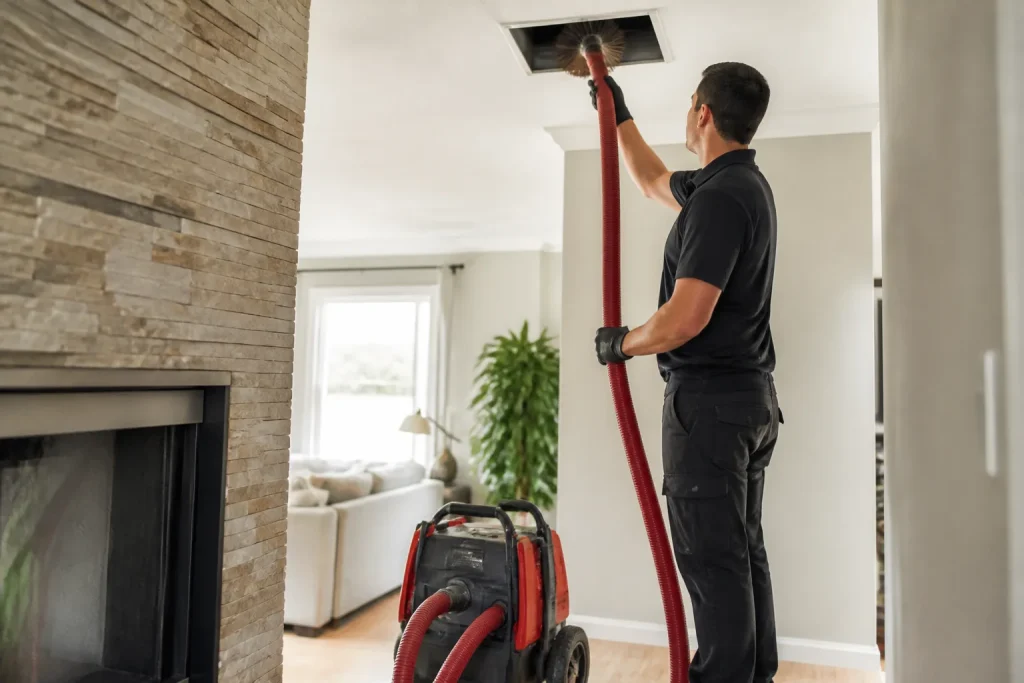
Smoke infiltration. This odor is sharp and acrid, like burned drywall or plastic. In Aliso Viejo, the most common source is a kitchen fire or a nearby wildfire. The concern with smoke is particulate, not just odor. Ash and soot deposit on the interior walls of ducts, the coil, and the blower wheel. A standard cleaning can address this, but only with agitation equipment that reaches the full length of the duct run, not just the first few feet at the register. That’s why we run professional-grade Rotobrush rotary brush systems for this kind of job, because surface-level vent wiping does nothing for what settled farther in.
Rodent intrusion. This smell is pungent, ammonia-heavy, and often accompanied by scratching sounds or debris at supply registers. Rodents get into attic duct runs, chew through flex duct, and nest inside return trunks. The critical point here is sequence: pest exclusion has to happen before duct cleaning, or you’re cleaning twice. If the entry point is not sealed, new animals move in within days. We can clean and repair the ductwork, but the homeowner needs a pest professional to close the access point first. A company that offers air duct cleaning should be honest enough to tell you that.
Sewage or moisture-activated odor. This smell is deeply unpleasant, earthy, and if it’s from a dry P-trap or a crack in a plumbing vent running near a return, it can get pulled directly into the air stream. If the odor is coming from a damaged section of duct in a crawlspace or wall cavity, the scope changes from cleaning to repair. Broken return ductwork under the house pulls crawlspace air, which carries whatever is down there, into the entire home. That’s an air duct repair job, not just a cleaning. We carry that capability, but the assessment has to happen before anyone hooks up equipment.
Post-Wildfire Ash in Aliso Viejo: What to Document Before Anyone Cleans
Aliso Viejo sits near wildland-urban interface zones, and when regional fires burn, ash doesn’t wait for an invitation. Fine particulates get pulled into return ducts through attic vents, garage-adjacent returns, or gaps in the duct system itself. The first thing to understand is that not every home needs emergency cleaning after a smoke event. The second is that if yours might, you need documentation before the cleaning starts.
Here is what to photograph and note before anyone disturbs the system:
- Any visible ash on vents, registers, or around the return grille.
- Discoloration on the filter. If the filter is darkened unevenly, note where the heaviest staining sits.
- Any smoke odor present at startup, and whether it fades or persists after the system runs.
- The condition of flex duct visible in the attic, if you can inspect it safely. Ash clings to the outer jacket, and that’s evidence of what drifted through the space.
A reputable company will scope before quoting. That means someone actually looks at the system, checks the return and supply runs, and tells you whether the ash burden justifies cleaning. A company that quotes over the phone without seeing the job is guessing, and in a post-fire situation, guessing cuts both ways. You either pay for cleaning you don’t need, or you skip cleaning you do.
For insurance documentation, the photos and notes go a long way. Many policies include provisions for smoke and ash damage to mechanical systems, but the adjuster needs to see the condition of the ducts before they’re cleaned. Once the interior is scrubbed, the visual evidence is gone.
What “Emergency Duct Cleaning” Actually Means, Operationally
Let’s be straight about what same-day looks like. A genuine emergency in ductwork does not mean a truck is parked outside your Aliso Viejo home in 45 minutes with equipment rolling. What it should mean is this:
- Same-day assessment. A technician arrives, inspects the system, identifies what the contaminant is, and tells you honestly whether cleaning is the right response or whether you need repair, pest exclusion, or something else first.
- Next-day full cleaning in most cases. The actual mechanical cleaning, the full-length agitation, the negative-air extraction, takes hours on a typical Aliso Viejo home. It’s a scheduled job, not a 30-minute stop.
- Containment during the wait. After assessment, a good company will advise you on interim measures so the home stays livable until the full cleaning happens.
When we respond to a duct emergency, the equipment that matters is containment-first. We run Abatement Technologies units to establish negative pressure at the point of cleaning, and Nikro HEPA-rated vacuum systems to capture what the agitation loosens. The goal is contaminants captured, not redistributed. That phrase matters more in an emergency than any other time, because the homeowner’s anxiety is already high and the wrong process makes the air worse, not better.
The Hours Between Shutoff and Service: Interim Steps That Actually Help
You’ve killed the system. You’ve called for assessment. Now you’re sitting in an Aliso Viejo house that smells like something and you don’t want your family breathing more of it. These steps make a meaningful difference:
- Run a portable HEPA air cleaner in the room where the family is spending time. Not an ionizer. Not an ozone generator. A true HEPA unit traps particulate and reduces the circulating burden while the HVAC is off.
- Seal off the room or rooms closest to the contamination source. If the odor is strongest at one return, close the door to that room and keep the door closed. This is about limiting spread across the floor plan.
- Do not run the bathroom or kitchen exhaust fans while the HVAC is off. Exhaust fans pull air out of the house, which creates negative pressure that can draw contamination from the ductwork or wall cavities into the living space.
- If the odor source is unknown or possibly sewage-related, ventilate carefully. Opening windows on opposite sides of the house helps if the outside air is clean. It can hurt during an active wildfire smoke event, because you’re trading one contaminant for another. Use judgment, or ask the technician when you call.
For households with allergy or asthma concerns, interim filtration is not optional. The particulate load from smoke or rodent contamination lingers for days if left alone, and a portable HEPA unit is the right bridge until the system can be properly cleaned. If you want a more permanent post-cleaning upgrade, we carry and install Honeywell and Aprilaire filtration products that slot into the existing system. That’s a conversation for after the emergency is handled, not during it.
When to Call a Pro, and When It Can Wait
If the odor is smoke, rodent, or sewage, call. That’s the short version. Duct contamination does not self-resolve, and the longer particulate sits inside the system, the more it gets re-entrained every time the blower runs. Even after the initial odor fades, the particulate remains, and that matters for anyone in the home with respiratory sensitivity.
If the issue is dust or general buildup, that’s not an emergency, and it can be scheduled as a routine cleaning. The question to ask yourself is whether the system is actively making the air worse right now. If yes, shut it off and call. If no, take a breath and book a normal appointment.
Related services in Aliso Viejo: If your duct emergency involves a dryer vent, that’s a separate system with its own risks, and we handle dryer vent cleaning as a focused service. Dryer lint fires are a real risk, and a blocked vent is not something to postpone.
The Bottom Line
A duct emergency in Aliso Viejo has a sequence, and the sequence starts before anyone touches a phone. Kill the air handler at the thermostat and breaker. Identify the odor category, because smoke, rodent, and moisture each point to a different scope. Document what you see, especially if post-wildfire ash is involved and insurance might come into play. Then call a company that scopes before it quotes, uses containment-grade equipment, and can handle repair if the ductwork itself is compromised.
Clean ducts are only half the job. Intact ducts are the other half. If you’re in Aliso Viejo and dealing with smoke, odors, or suspected contamination in your duct system, call Duct Cleaning Aliso Viejo at (833) 693-2761 for a free estimate. We answer 24/7. Fast dispatch from 7am to 7pm, Sunday through Friday.
Frequently Asked Questions
Assessment can be same-day. Full mechanical cleaning of the entire duct system usually happens the next day, because the job takes hours, not minutes. Any company promising a complete emergency cleaning within an hour of the call is not doing the work properly.
The price is set per job by a written estimate after a technician assesses the system. The estimate is free, and the scope, whether cleaning only, or cleaning plus repair, determines what the work costs. Call (833) 693-2761 for an exact quote.
No. Turn the system off at the thermostat and the breaker. Running the system distributes smoke particles, ash, and odor to every room in the house. Shutoff is the first step, before calling anyone.
Technically yes, but the pest entry point must be sealed first. If rodents can still get in, cleaning the ducts is a temporary fix, and the contamination returns within days of new animals moving in. A proper response is exclusion first, then cleaning, then any necessary duct repair.
Written by the team at Duct Cleaning Aliso Viejo, serving Aliso Viejo since 2016.
Need Air Duct Cleaning Help?
Call Duct Cleaning Aliso Viejo - licensed & insured, with free written estimates in Aliso Viejo.
(833) 693-2761